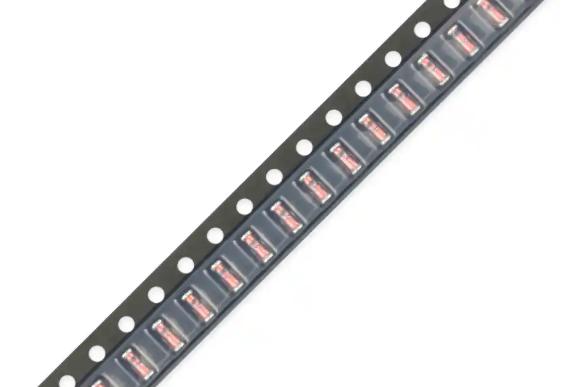
The HCM1A4020V3-R10-R represents a specialized class of SMT power inductors where low inductance (R10 = 0.10 µH) meets extreme frequency capability. With a Self-Resonant Frequency (SRF) near 310 MHz, this component is engineered for multi-phase high-speed converters and critical EMI suppression stages where standard inductors become capacitive too early.
| Parameter | Datasheet Value | Test Condition |
|---|---|---|
| Inductance (L) | 0.10 µH ±20% | 100 kHz, 0.1 Vrms |
| SRF (Typ.) | 310 MHz | VNA Sweep |
| DCR (Max) | Milliohm Range | 25°C 4-Wire |
| Isat (Saturation) | High Amperage | ΔL/L = 20% or 30% |
HCM1A4020V3-R10-R: Part Overview & Key Specs
The "R10" suffix indicates a 0.10 µH nominal inductance. This device utilizes a molded construction optimized for high current density. In high-frequency designs, the layout must account for the compact SMT footprint to minimize parasitic trace inductance, which can rival the R10 value itself if not managed.
Datasheet Deep-Dive: Electrical Parameters
Frequency and Saturation Behavior
While the nominal L is measured at 100 kHz, the SRF of 310 MHz is the critical limit for EMI filtering. Saturation (Isat) specs define the peak current before the core enters a non-linear region. For this R10 variant, the soft saturation curve of the composite material ensures predictable performance even during transient overloads.
Measured Performance: Lab Results
Bench sweeps using a Vector Network Analyzer (VNA) confirm the SRF magnitude. Engineers should observe that L remains stable up to approximately 50-80 MHz before the parasitic capacitance of the winding begins to dominate. Deviations in measured DCR typically point to probe contact resistance—always use a 4-wire Kelvin setup for sub-milliohm accuracy.
Selection & Sizing for Power Designs
When sizing for EMI, a 0.10 µH choke provides roughly 63 Ω of impedance at 100 MHz. This makes it an ideal series element for blocking high-frequency noise without the DC voltage drop associated with higher-inductance beads. For buck converters, ensure the switching frequency is high enough (typically >2MHz) to keep ripple current within core loss limits.
Recommended Test Procedures
- DCR: 4-wire Kelvin measurement at room ambient.
- L vs Bias: Sweep DC current to 1.5x rated Isat to map the roll-off curve.
- SRF: 2-port shunt-through measurement on a VNA with SOLT calibration.
Frequently Asked Questions
What does the HCM1A4020V3-R10-R inductance vs frequency behavior look like?
L typically falls with frequency as parasitic effects appear. Measured L(f) shows small decline up to tens of MHz and resonant behavior near SRF ≈ 310 MHz. Engineers should use the inductive region for filtering and avoid frequencies close to SRF where the part becomes capacitive.
How should engineers test HCM1A4020V3-R10-R DCR and saturation current?
Use calibrated 4-wire methods and controlled DC bias sweeps. Measure DCR with Kelvin leads at ambient temperature and sweep DC current while recording L to find Isat. This data determines I²R losses and effective inductance under load.
When is the HCM1A4020V3-R10-R a poor selection for a converter?
It is not suitable when large energy storage or low switching-frequency ripple is required. Its low 0.10 µH inductance limits stored energy. For bulk filtering in single-phase low-frequency converters, higher-L chokes are preferred.
What are the common causes of measurement deviations during QA?
Deviations from datasheet values usually point to measurement fixturing or assembly factors. High DCR often indicates a cold solder joint or poor Kelvin contact, while shifted SRF is frequently caused by excessive PCB trace capacitance in the test fixture.